AWS Is Charging You 3x More for Slower Compute. We Have the Benchmarks to Prove It
Sustained benchmarks comparing Huddle01's $22/mo VM against AWS t3.medium and c7i.large on real engineering workloads
Published
Feb 6, 2026
Category
Engineering
Author
Akash Mondal
We ran sustained benchmarks comparing our $22/mo instance against AWS t3 and c7i. Real workloads, real tools, 30+ minutes per test. Here's every number.
Key results:
82% faster on concurrent traffic vs AWS c7i ( at 3x the price )
5x more IOPS, 7x lower latency on disk I/O
~50% faster CI/CD builds vs t3
AWS t3 crashed under sustained load
Here's something that's always bugged me about the cloud industry. Nobody tells you what a "vCPU" actually is
You're paying for a slice of a processor but you have no idea if it's a modern chip or some 2015 leftover that throttles the second you actually use it.
At Huddle01, we built our cloud on modern AMD processors with unthrottled NVMe storage. We knew it was fast because we use it ourselves. But "trust me bro it's fast" doesn't cut it when you're asking engineers to move their infra.
So we put numbers behind it.
We took our standard $22/month instance and put it up against two AWS instances:
The price match: AWS
t3.medium(~$30/mo), what most startups default toThe big gun: AWS
c7i.large(~$61/mo), AWS's compute-optimised Intel Sapphire Rapids instance. Almost 3x our price.
No synthetic scores. No Geekbench nonsense. We ran actual engineering workloads, video transcoding, CI/CD builds, high-concurrency web servers, and database I/O.
Here's what happened.
The Rules We Set
Anyone can cherry-pick a benchmark. We didn't want to do that. So we set four rules before we started:
Run everything for 30+ minutes. Most cloud benchmarks run for 60 seconds which is basically useless. Burstable instances like AWS T3 look amazing for the first minute and then fall off a cliff. We wanted to see what happens in production, not in a demo.
Same OS, same kernel, no tricks. Fresh Ubuntu 24.04 LTS (Kernel 6.8) installs on everything.
Real tools only.
ffmpeg,go,make, andpostgres(via fio). Tools that engineers actually use.Open source everything. All the scripts are in the appendix. Run them yourself. If our numbers are wrong, call us out.
The Specs
Feature | Huddle01 | AWS | AWS |
|---|---|---|---|
Processor | AMD EPYC™ Genoa (Zen 4) | Intel® Xeon® Platinum 8488C | Intel® Xeon® Platinum 8259CL |
vCPU Count | 2 vCPU | 2 vCPU | 2 vCPU |
Memory | 4 GB (DDR5) | 4 GB (DDR5) | 4 GB (DDR4) |
Storage | NVMe (Unthrottled) | EBS gp3 (Baseline 3000 IOPS) | EBS gp3 (Baseline 3000 IOPS) |
Monthly Price* | ~$22.32 | ~$64.26 | ~$32.25 |
Prices based on AP-South-1 on-demand rates as of 21 Jan 2026.
1. Heavy Traffic
What we did: Go web server resizing 50 concurrent images (1024px → 256px) with Lanczos filters.
Basically what any backend does under real traffic. An API processing images, a media server handling uploads. It hammers CPU, memory bandwidth, and scheduler all at once.
Cloud Provider | Instance | Processor | Score |
|---|---|---|---|
Huddle01 |
| AMD Genoa | 84.26 RPS |
AWS |
| Intel Sapphire Rapids | 46.18 RPS |
AWS |
| Intel Cascade Lake | 28.44 RPS |
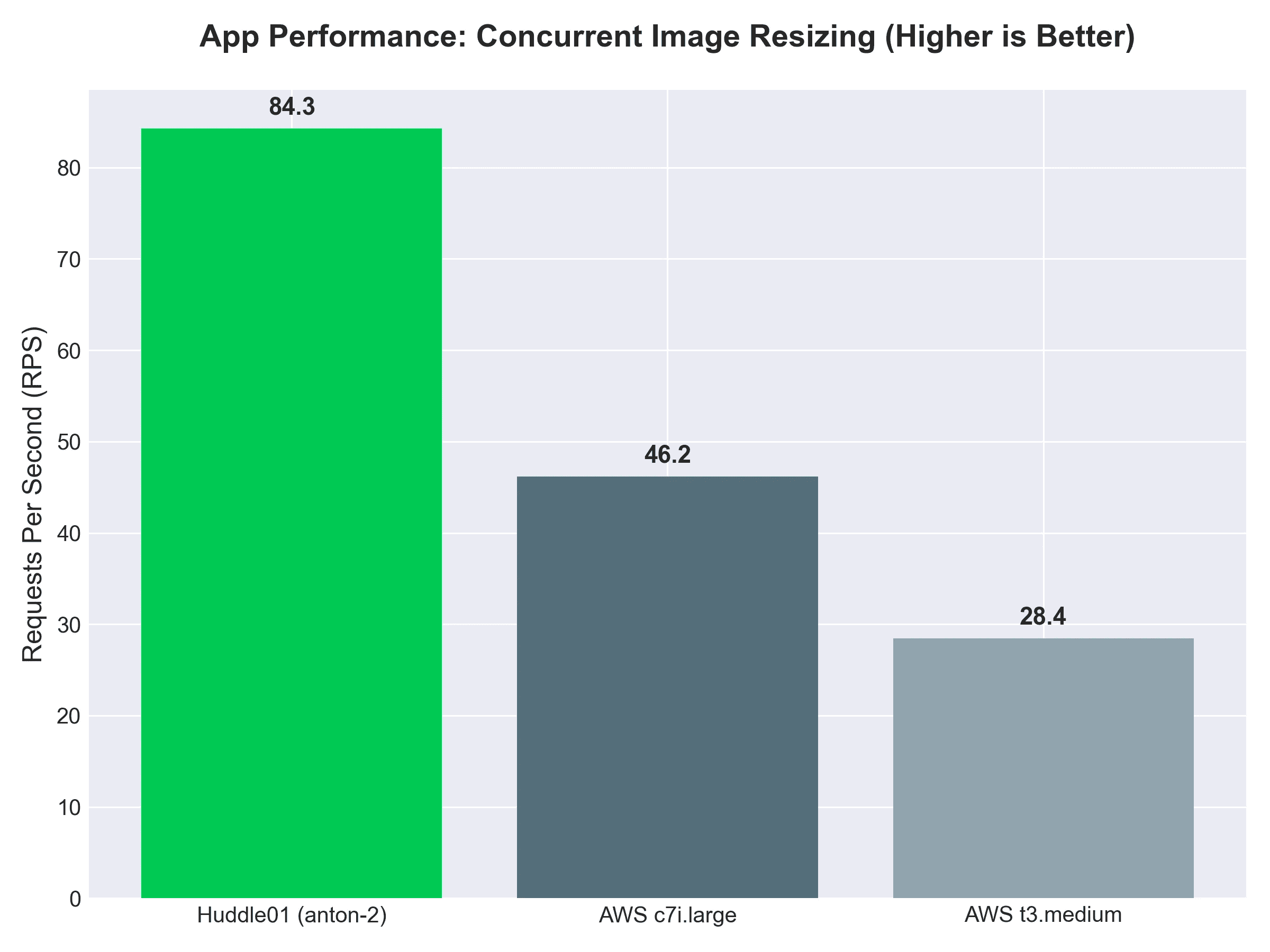
This one genuinely surprised us. We expected to beat the T3. We did NOT expect to be 82% faster than AWS's $61/month compute-optimised instance.
And the T3? It didn't just lose. It crashed. Under sustained load it burned through its CPU credits instantly and gave us 150 connection timeouts. If you're running any kind of production workload on T3 instances with real traffic... honestly? You're playing with fire.
2. Video Transcoding
What we did: Transcoded 4K "Big Buck Bunny" down to 1080p using ffmpeg.
Pure floating-point (AVX) performance. If you're doing anything with video, audio, or AI inference, this is the number that matters.
Huddle01: 13 minutes
AWS c7i: 19 minutes
AWS t3: 32 minutes ( throttled to death )
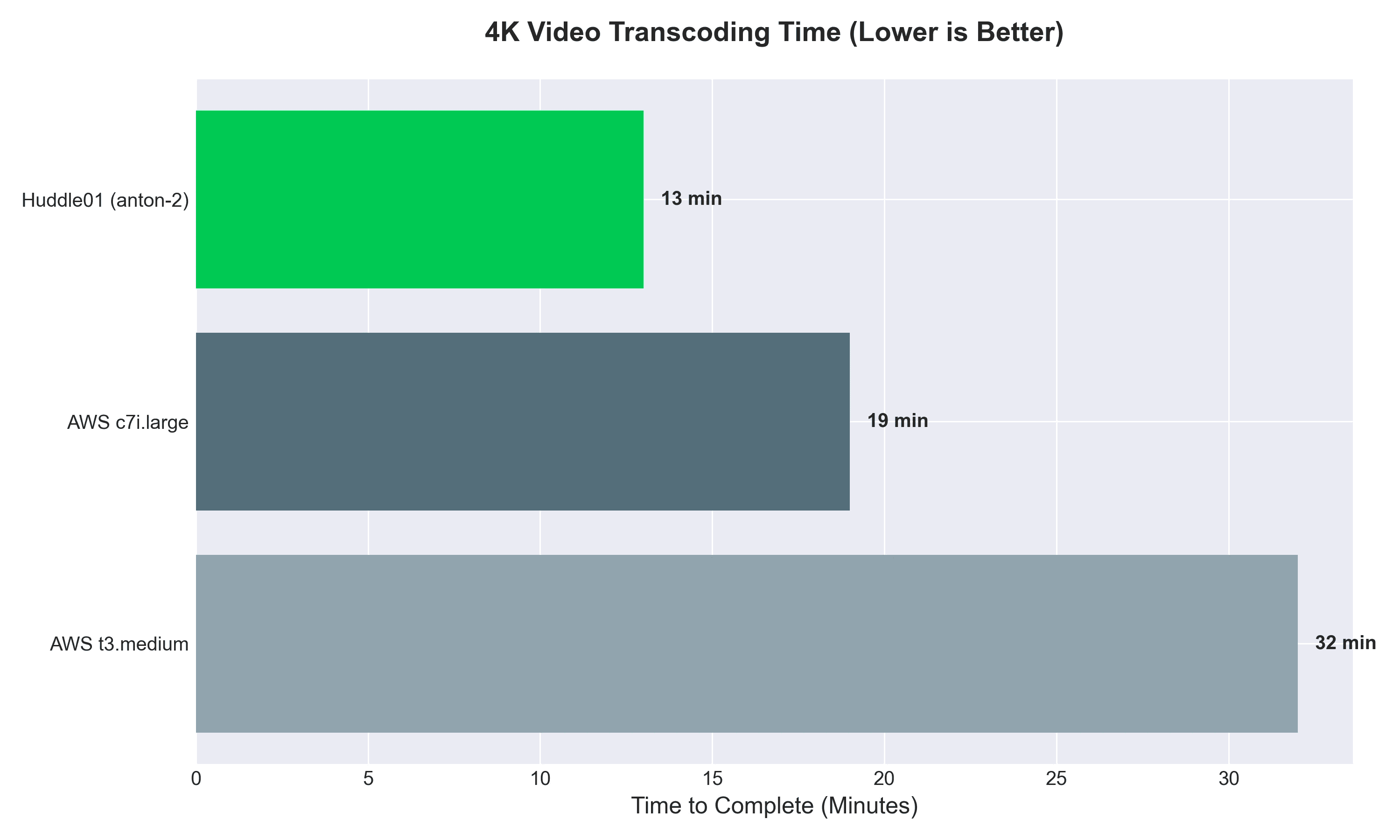
Think about this. You're paying 3x the price on C7i and waiting 43% longer for the same job. AMD Genoa + no throttling = massive gap for compute-heavy work.
3. CI/CD Builds
What we did: Compiled Redis 7.2 from source (make -j2).
Every time your CI/CD pipeline runs, GitHub Actions, Jenkins, whatever, this is what's happening under the hood. Faster this is, less time you spend staring at a loading bar.
Huddle01: 67.01 seconds
AWS c7i: 84.26 seconds
AWS t3: 128.33 seconds
Moving your CI/CD runners to Huddle01 would cut build times by nearly 50% compared to standard AWS instances. And you'd be paying less. That's not a tradeoff, that's just better.
4. Disk I/O
What we did: fio random read/write test simulating a busy PostgreSQL database.
This one genuinely pisses me off about traditional cloud providers. They throttle your disk speed to a "baseline" and then charge you extra for "Provisioned IOPS" when you need actual performance. Like what the hell.
Huddle01: 13,380 IOPS (Latency: 5.7ms)
AWS c7i: 2,286 IOPS (Latency: 41ms)
AWS t3: 2,266 IOPS (Latency: 42ms)
Both AWS instances hit the artificial EBS baseline wall of ~3,000 IOPS. We don't have that wall. 5x the IOPS, 7x lower latency. Your database queries are just going to be faster. No expensive storage add-ons needed.
What We Didn't Test ( Being Honest )
No benchmark is perfect and I'm not going to pretend ours is.
Multi-region networking: AWS has a massive global private backbone. If you need private network routing between Tokyo and Virginia, AWS still has the edge. We're not there yet.
Auto-scaling at fleet scale: This was single-node testing. AWS's Auto-Scaling Groups and ALB ecosystem is more mature if you're managing hundreds of instances.
Managed services: If you need RDS, SQS, Lambda... AWS wins on breadth. We're a compute and storage play for teams that want raw power and know how to use it.
We'll get to all of this eventually. But on single-node performance per dollar? The numbers speak for themselves.
Takeaway
Comparison | Huddle01 | vs. AWS | vs. AWS |
|---|---|---|---|
Monthly Cost | ~$22 | ~$30 | ~$61 |
App Performance | High | Fails Under Load | 45% Slower |
Video Encoding | Fastest | 2.5x Slower | 30% Slower |
Disk Speed | Unthrottled | Capped | Capped |
If you're running a WordPress blog or a landing page, honestly use whatever you want. AWS is fine for that.
But if you're running real workloads, transcoding pipelines, CI/CD, heavy APIs, databases that need to be fast, you're paying a brand tax on AWS for worse performance. We built Huddle01 Cloud to be the infra we wanted to use ourselves. Turns out it's the infra a lot of engineers want.
Wanna see for yourself? Spin up an instance at Huddle01 Cloud and run the benchmarks.
Liked the article? Share it on socials.